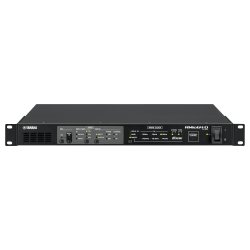
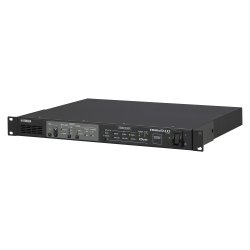
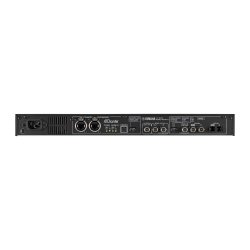
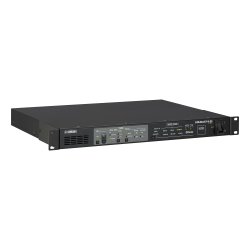
The RMio64-D Dante/MADI conversion I/O rack is here.
It supports a wide range of broadcast and live audio applications with exceptional flexibility, all without getting in the way.
Quiet and discreet, extraordinarily versatile
The ideal audio interface should, in essence, be imperceptible. This principle aligns with Yamaha’s philosophy of absolute fidelity to the original sound. Audio must not be altered during format conversion in the digital domain, and no extraneous noise can be tolerated. Performance should not be overly dependent on the user’s expertise or skills. It must be easy to connect devices over any practical distance and flexible enough to work around potential issues. The RMio64-D Dante/MADI conversion I/O rack is here. It supports a wide range of broadcast and live audio applications with exceptional flexibility without getting in the way.
Bridging formats with seamless efficiency
Word clock synchronization often becomes an issue when connecting different audio formats, but because the RMio64-D includes built-in sample rate converters on both inputs and outputs, you can simply connect it and forget about it—no worries about noise or dropouts.
Dante redundancy for a robust infrastructure
Audio interruptions must be avoided at all costs in commercial applications. Dante interfaces feature primary and secondary ports, making it easy to establish redundant connections for maximum reliability. If a cable is accidentally disconnected or a network switch fails, the system continues operating without interruption. Alternatively, the dual Dante ports can be used for simple daisy-chain connections (note: redundancy is not available for daisy-chained setups).
MADI redundancy via alternative cable types
In addition to Dante network redundancy, redundant MADI connections can be established via optical and coaxial cables. If the primary input signal fails, the system automatically switches to the secondary connection. Optical cables are ideal for long-distance transmission.
Dual MADI ports offer more than simple conversion
Two sets of MADI connections not only allow basic Dante-to-MADI conversion but also enable flexible routing. For example, MADI signals received via an optical input can be forwarded through a coaxial output. This allows MADI to be converted to Dante while simultaneously routing the MADI signal directly to another MADI device. This level of flexibility is one of the RMio64-D’s key strengths.
CL, QL, and R: Tight integration plus Nuage support
RMio64-D mounting, Dante patching, and SRC settings can all be remotely controlled from a CL- or QL-series console touchscreen (to be implemented in a future update). While the RMio64-D performs excellently on its own, as part of a Nuage system it provides direct monitoring functionality for recording, precise VST System Link synchronization, and remote control via the Nuage Workgroup Manager system software.
Use case example: supplying a MADI feed to an OB truck
A live audio system may include a CL console front-of-house and a QL console on stage. In addition to providing the monitor mix, the QL console’s Port-to-Port function allows it to operate as an I/O device with capabilities comparable to an R-series rack unit, reducing overall system size and complexity. The RMio64-D converts the system’s Dante signal to MADI for transmission to the OB truck offsite. Its built-in sample rate conversion efficiently resolves word clock synchronization issues.
Related products