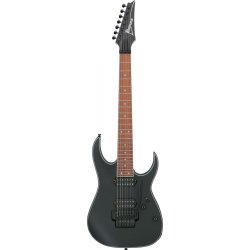
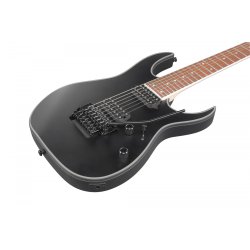
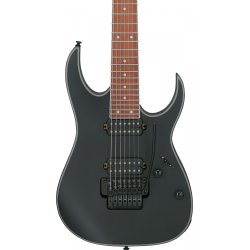
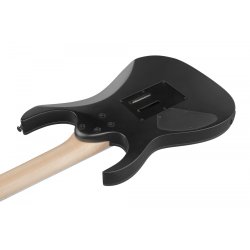
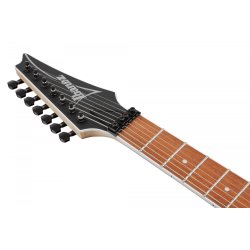
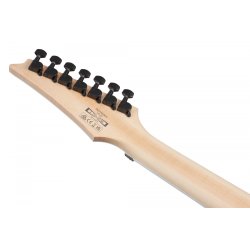
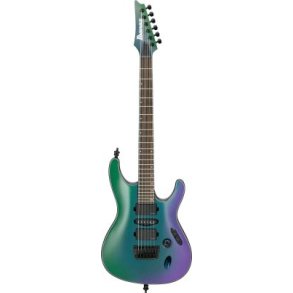
Wizard II-7 3-piece maple neck
- Meranti body
- Jatoba fretboard with white dot inlays
- Jumbo frets
- Quantum 7 (H) neck pickup
- Quantum 7 (H) bridge pickup
- Edge-Zero II-7 tremolo bridge
- D’Addario EXL strings (.009/.011/.016/.024/.032/.042/.054)
- Black hardware
Matching case: M300C
Matching gig bag: IGB540-BK
Neck Profile & Dimensions
- Scale length: 648 mm (25.5")
- Width at nut: 48 mm
- Width at last fret: 68 mm
- Thickness at 1st fret: 19 mm
- Thickness at 12th fret: 21 mm
- Fingerboard radius: 400 mm
Electronics & Pickup Configuration
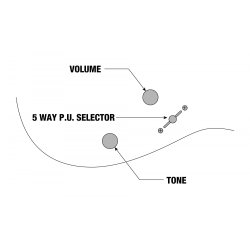
The pickups are Ibanez QM-7 humbuckers, wired to a 5-way selector switch with master tone and volume controls.
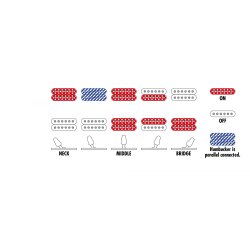
Switch Positions:
-
Bridge pickup in series*
-
Bridge pickup split** combined with split middle pickup
-
Middle pickup
-
Neck pickup with coils wired in parallel***
-
Neck pickup in series
Series Wiring
In series mode, both coils of the humbucker are connected in series, delivering the full output and tonal character the pickup is designed for. This is the standard configuration typically described in the manufacturer’s specifications. In this mode, the pickup is hum-cancelling and virtually noise-free.
Coil Split
When a humbucker is split, one of the two coils is deactivated, turning the pickup into a single-coil with only one active coil. Output and signal strength are typically reduced to approximately half of the series configuration. At the same time, the pickup loses its hum-cancelling properties.
However, in switch positions 2 and 4, the system remains hum-cancelling, as the active coil from either the bridge (position 2) or neck pickup (position 4) is wired in parallel with the middle pickup.
Tonally, coil-splitting produces a weaker, brighter, and more open sound with a cleaner and more defined low end. This configuration is particularly well suited for clean and lightly overdriven tones – or for opening up a heavily distorted sound to add clarity and transparency.
Since only one coil is active, it is possible—by physically reversing the pickup—to choose whether the active coil is positioned closer to the neck or the bridge. This affects the tone: warmer near the neck and brighter/clearer near the bridge.
Parallel Wiring
In parallel mode, both coils remain active but are connected in parallel rather than in series. This results in lower output, a cleaner and more transparent tone, and slightly reduced bass response compared to series wiring.
The degree of output reduction depends on the pickup’s construction. For humbuckers with two identical coils, parallel wiring typically delivers approximately 25–33% of the output compared to series mode, while other designs may retain up to 50%. Electrically speaking, resistance (ohms) is generally reduced to about one quarter of the series value when wired in parallel (for pickups with two identical coils).
The reduced output also increases dynamic response: the tone becomes less compressed and reacts more sensitively to picking attack and playing nuances. The difference between light and heavy pick attack becomes more pronounced.
Parallel wiring is an extremely useful option for achieving a lower-output, cleaner, and more dynamic tone—most commonly used in the neck position. It is ideal for producing a clear and well-defined clean sound from a relatively hot humbucker that might otherwise sound congested or compressed. It can also help add definition to distorted neck tones or create a more open and lively crunch character.
Although the measurable drop in output may seem significant on paper, in practice—especially with distorted tones—it is perceived as less dramatic. For high-output humbuckers, parallel wiring is often a more musical and versatile alternative to coil-splitting when seeking lower output and a more dynamic response, while still retaining hum-cancelling performance and low noise.